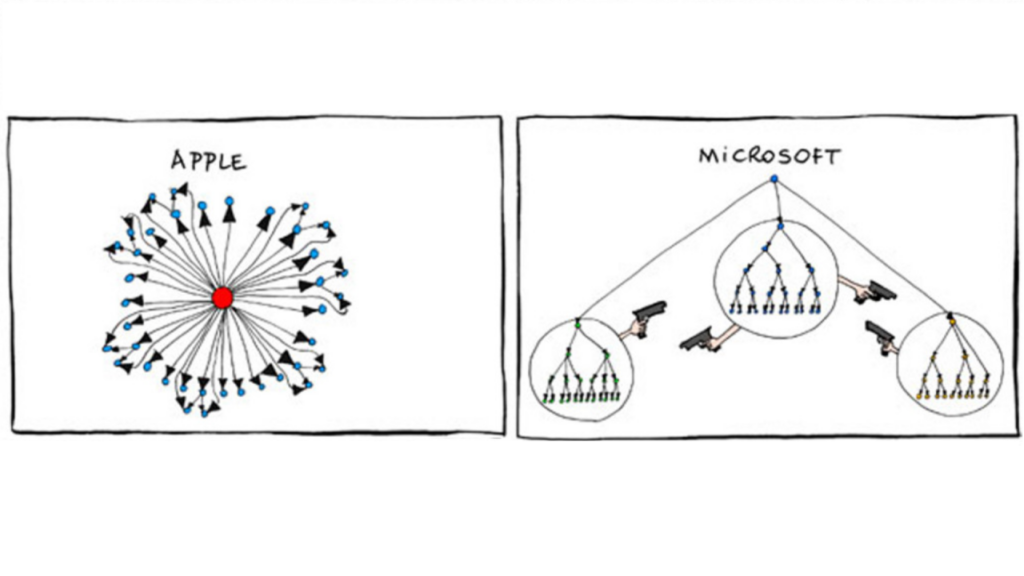
Anyone who has worked in technology has probably dealt with a competitive situation.
Maybe it’s trying to position your solution against all the others companies’ products, perhaps it’s the annual performance review tussle with your so-called “co-workers” or you’re just trying to get funding or investment from the higher-ups to get something done (when they might prefer to spend the money elsewhere). It can be exhilarating and exhausting.
Competing with other external parties to deliver a service or a product probably sharpens the minds of the people developing it, so in theory having strong competitors should make you stronger too (or you don’t survive). But does internal competition improve offerings, make the organisation more efficient, or is just a giant distraction? If “leaders” spend time fighting with each other instead of focussing on the end goal, maybe they’ll eventually lose out to more agile or innovative competitors [See IBM, HP, Digital, Intel…]
Some companies have consciously fostered internal competition or even conflict to accelerate their own developments. Occasionally, companies will pool resources with erstwhile competitors to help them innovate more quickly or to gang up against even stronger companies.
Microsoft and Apple
Both Microsoft and Apple have evolved through several phases from the mid-1970s until now. For Apple, there was the first era of founding Steves Jobs & Woz, then Jobs booted out and Apple nearly going bust, Jobs coming back and saving the world, before Tim Apple took the company to be the biggest in the world.
Microsoft had a parallel of Bill & Paul founding and expanding in the early days of microcomputing, to Windows dominating the OS landscape, Steve Ballmer taking over and laying some of the groundwork for the transformation to being a cloud company that Satya has driven.
Not many companies get to pivot so many times and still be not just relevant but at the front of their field. They’re still 2 of the most valuable companies ever, by market cap, at time of writing, stocks can fall as well as rise etc etc. Somewhat ironically, since starting to write this piece, Google has overtaken Microsoft for the first time, their value more than doubling in less than 8 months.
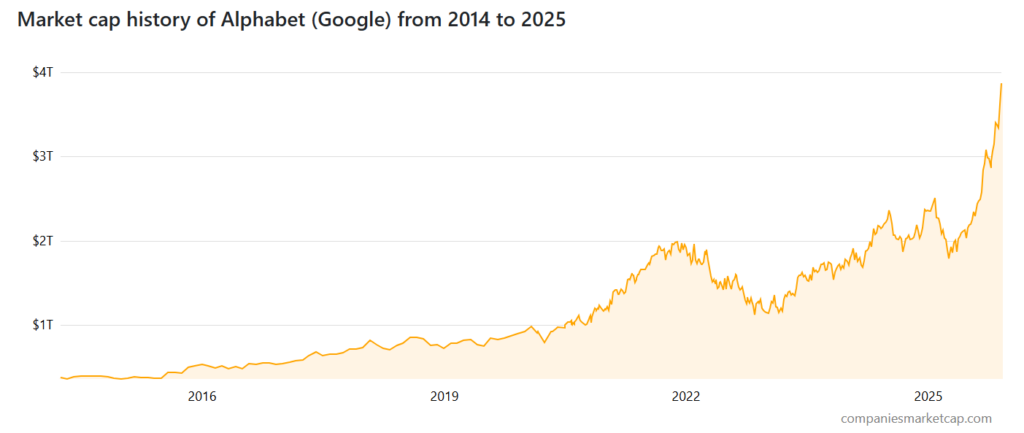

A bubble, you say? Shurely shome mishtake.
Maybe the presence of a talismanic founder or two can help companies in their early stages – in Robert X Cringely’s excellent historical guide to the early days of the microcomputer industry, Accidental Empires (1992), he addresses both Jobs and Gates. Chapter 10, “The Prophet”, starts by calling Steve “The most dangerous man in Silicon Valley”. Bill, in “Chairman Bill Leads the Workers in Song” is characterised as the Henry Ford of the microcomputer industry.
Sometimes, Bill is said to have actively fostered internal competition between different groups rather than imposing a way of doing things – the thinking being that if two or three groups each try to solve a problem then the best solution will win.
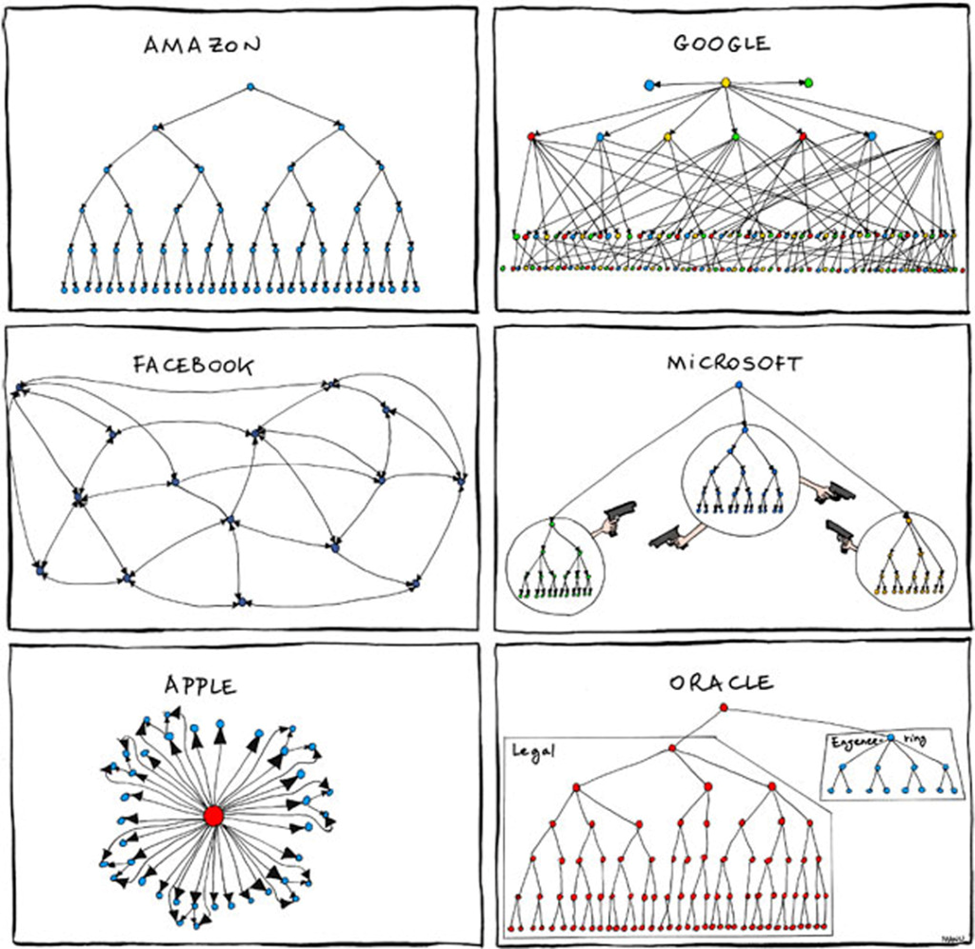

This old joke org chart comparison illustrates a few truisms – at Google, Larry & Sergei might have had the ideas, but Eric Schmidt ran everything. Oracle perhaps spent more on enforcing licensing than on engineering, and at Apple (post 1996), everything revolved around Steve and all decisions went back to him.
But if you were at Microsoft in the early 2000s, you’d smirk with recognition at the warring nature of how their product groups sometimes behaved.
MS: Not just about Windows
For many years, Microsoft had the two cash cows of Windows and Office. The Operating system was licensed to PC manufacturers and sold to enthusiasts and businesses who upgrade every few years. People even queued at midnight on August 24th 1995 to buy a copy of Windows 95; apocryphal stories did the rounds of some shoppers not even owning a computer but they got caught up in the hype for fear of missing something.
Internal influence was rather staked on which part of the division you worked in – Windows, especially under BillG’s tenure when everything else pretty much had to support the Windows business, was the big dog. Office was somewhat secondary but also made Mac versions and was bought by people devolved from whatever cycle they replaced their PC or upgraded its operating system. Server products which ran on Windows NT Server but were tied into usage of Office somewhat straddled the two.
It wasn’t uncommon for Microsoft to have multiple products which overlapped yet were built by different teams – Windows 3.x vs OS/2, Windows 95/98 vs Windows NT, Office vs MS Works, Internet Explorer vs MSN. Even within product groups, there were often numerous bits of technology being developed which had already been built by another team (at one point there were 3 or 4 different and incompatible ways of doing “workflow” processes).
There’s no doubt that there was wasted effort – products would go through long development cycles only to be canned before release (or like KIN, shortly after). In a remarkably honest interview to coincide with Microsoft’s 50 years anniversary, Steve Ballmer admitted there were silos between productivity and systems divisions. A very in-depth interview with Steve on the Acquired Podcast delves deeper into his regrets around the “Longhorn” development that cost the company years.
Show me the money!
Between 1997 and 2000, the company’s revenue grew from $12Bn to $23Bn but net income nearly tripled from $3.5 to $9.5Bn. What was behind the success? Enterprise software sales. The steady growth of Windows NT and the associated client licenses for running back-office servers, along with SQL Server database and Exchange Server for email was really paying off.
By comparison, Microsoft’s FY25 numbers came out at $281.7Bn with a net income of $101.8Bn – even adjusting the FY2000 numbers using the Bank of England Inflation calculator, the latest figures are remarkable. 2025 revenue is 641% of 2000’s and net income is 561%.
Over time, Microsoft shifted away from just being dependent on Windows & Office, by adding numerous other successful businesses, focusing on Enterprise then the cloud and latterly bunging AI into every offering.
Every quarter when they release fiscal results, Jack Rowbotham posts on LinkedIn summarising where the money flows – and using visuals produced by App Economy Insights it’s quite clear where the power lies now.
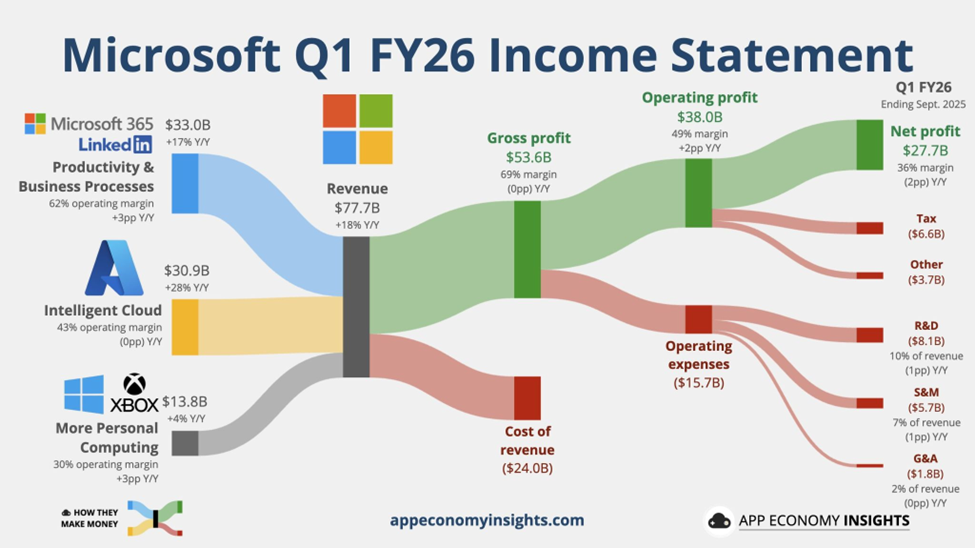

Whatever you think of Microsoft, if you cut the company, they bleed software (and services).
Hardware has always been a means to an end – to sell and use the software. The original Microsoft Mouse was just a way to get people used to the graphical interface that would eventually be the key UX of Windows. Today, Surface devices aim to show how a great PC can be and, for now at least, Xbox continues to be the means to sell more games (and Game Pass subscriptions).
Apple – the Return of the King

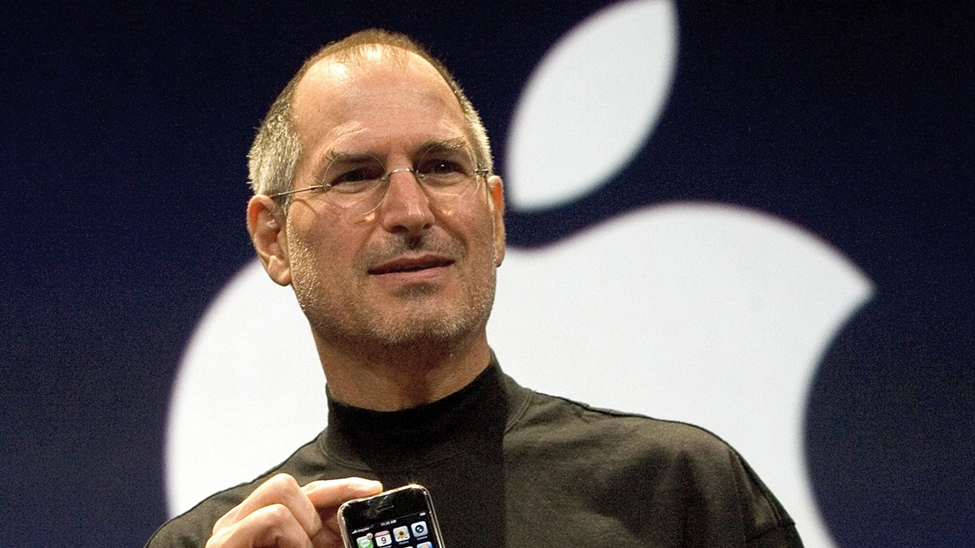
Microsoft and Apple have had a “complicated” relationship since the early days.
Bill and Steve had a degree of respect and even friendship for each other, but as both companies became successful there were clearly times when they were at loggerheads.
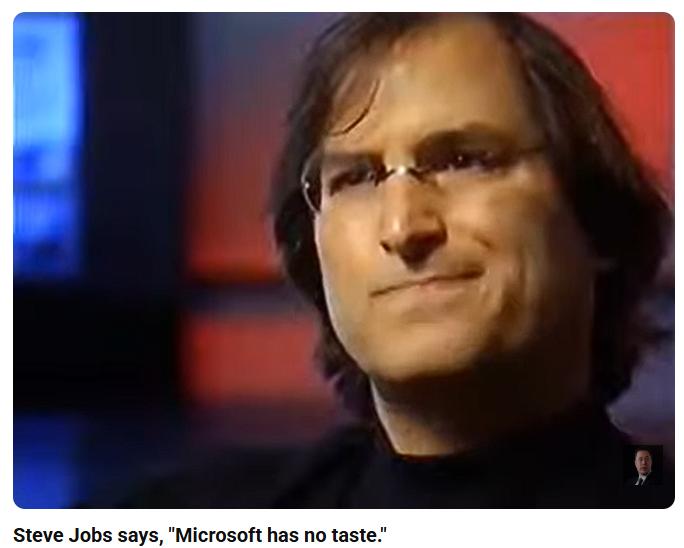

In that seminal interview, Steve lays out his vision for humanity of taking the very best of things to improve itself, casting Apple as true innovators and Microsoft as pedestrian followers.
Jobs famously went to visit Xerox PARC and took inspiration from what they were doing with graphics, mouse, printers and networking as the genesis of the Apple Lisa and later Macintosh products. The Mac has always been a niche offering – arguably beautiful, proprietary and expensive, it could never really compete for the mainstream in the same way that Mercedes or Jaguar or BMW were always going to be in a different league to Ford and Toyota.
The PC and DOS had become hugely successful and when Microsoft debuted Windows, Apple was clearly not happy. Lower-cost, more diverse PCs with many peripheral and software companies building on top of them competed against the Macs with relatively few software packages being developed. Jobs was fired by Apple in 1985. There were attempts to create other products, like the Newton, but they proved unsuccessful and perhaps a costly distraction.
Apple was circling the drain, and at the time of Jobs’ return in 1997, it was said that Microsoft made more money selling Office to Mac users than Apple did selling Macs to Mac users.
Quoting Bob Cringely again, whose book was published before Steve Jobs came back to save Apple from itself:
Steve Jobs holds an idea that keeps some grown men and women of the Valley awake at night. Unlike these insomniacs, Jobs isn’t in this business for the money, and that’s what makes him dangerous.
Jobs came back and brought in some help from outside – including Larry Ellison from Oracle, despite the boos from the faithful. Steve began admitting that Apple would like to do some software and having software industry expertise on the board might be a good idea.
He also suggested that Apple and Microsoft were going to partner more closely – as a way of resolving some long-time disputes relating to look and feel of Windows and Mac, and Microsoft agreeing to keep supporting the Mac platform with releases of Office at the same cadence of the ones for Windows.
Microsoft was also going to pump some cash in to make sure Apple was kept alive (a useful bet against the Department of Justice, who were breathing down Redmond’s neck at the time). The $150M of non-voting stock that Microsoft bought was sold 6 years later for $550M, so that worked out well.
The jeers from the Apple fans at Macworld 97 were not just reserved for Larry from Redwood: Bill from Redmond got even more.
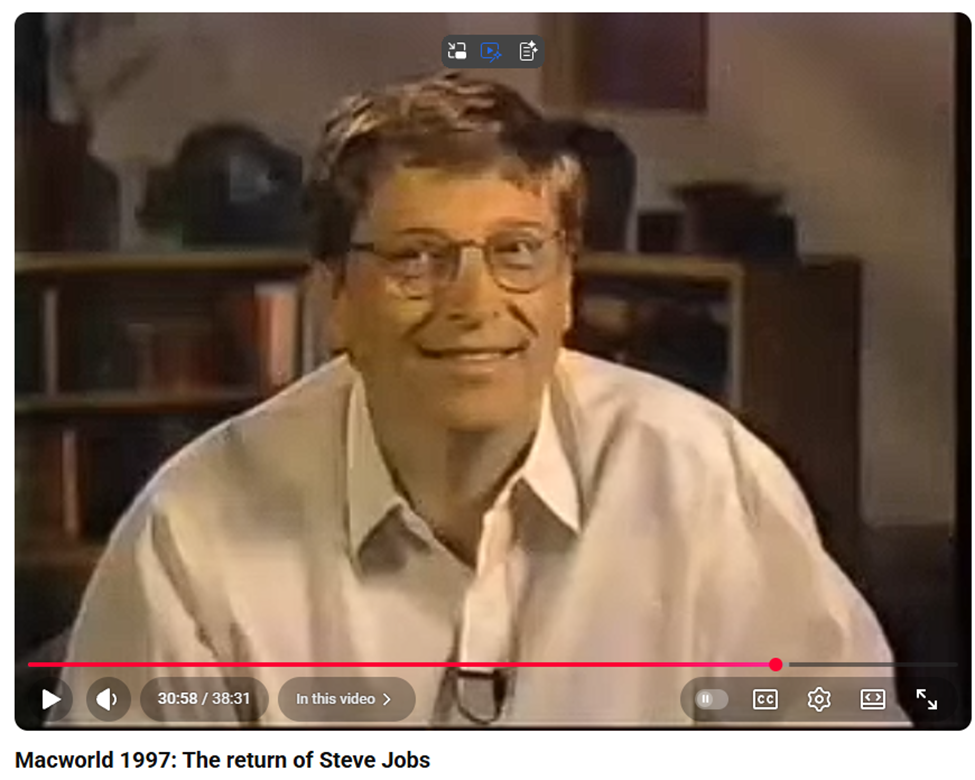

Jobs made a hugely important point to the Macworld congregation at the time: they need to let go of the idea that for Apple to win, Microsoft has to lose. This idea that competitors can sometimes work together for mutual benefit or even survival is clearly valid.
Apple makes Things
Meanwhile, Apple has gone from near death to world dominance. Jobs led an obsessive focus on customer experience, which made sure they built products that people loved. The iMac injected some pizazz into the ageing Mac product lineup, launched a hugely successful laptop line in PowerBook and MacBook, and came up with a variety of ancillary products like the iPod, iPhone, iPad and Apple Watch. By Q1 2007, the iPod on its own was responsible for almost half of Apple’s revenue.
The iPhone was the true saviour of Apple. For the first time, it attracted new customers to the brand, and they’d go on to buy Macs because they liked the experience (and the integration was well thought out). But it had a difficult gestation: Jobs deliberately kept the development of iPhone separate from the Mac, with direct oversight and freedom for that design team. He fostered direct – sometimes hostile – competition for the software platform to be used in the phone. Either the iPod would grow to become a phone, or the Mac OS X would be shrunk to form a new OS. The latter prevailed.
Looking at Apple’s fiscal makeup today, you can see that the majority of its revenue comes from products like iPhone, but services like iCloud, Apple TV, iTunes etc make up 28% of its revenue but 45% of its gross profit.
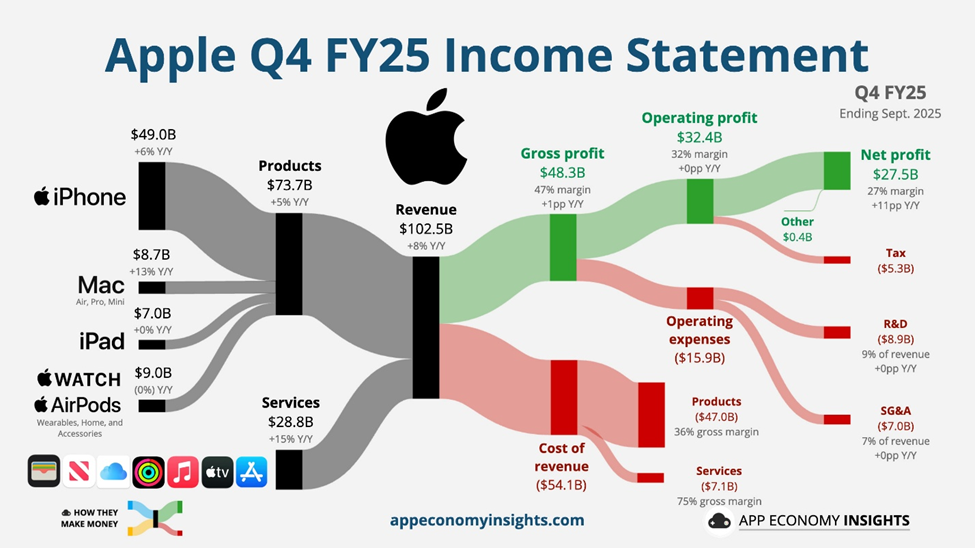

If you cut Apple, it bleeds devices and the related experience. They make great hardware which people love because the design and the software that drives it is well thought out. But the profitability growth is really behind the subscription services that provide that experience: nearly 45% of Apple’s gross profit comes from that services line, even though it accounts for only around one quarter of its revenue.
Are they still competitors?
Having been frenemies for some time and outright competitors for years (remember the I’m a Mac adverts? … not sure some of them would make the cut these days), do Apple and Microsoft still see each other as even relevant let alone a threat or opportunity?


Well, Windows still has the lion’s share of the desktop OS, though it’s fallen from around 85% to 65% over the last decade. The key thing is, the desktop has lost its dominance with more people using phones and tablets, and since Microsoft failed to compete in the phone OS and never really built a compelling tablet, it’s even stevens.
In its early days, Apple’s iCloud storage was partly on Amazon’s AWS and partly on Microsoft’s Azure cloud service – in fact, Apple was among the largest 3rd party users of Azure at the time. Reportedly, iCloud moved to Google Cloud and kept on using AWS for some too, alongside massive investments in their own datacenters.
Nowadays, Microsoft pretty much bundles Office in with a subscription so Mac users might not be counted a significant revenue stream on their own. M365 doesn’t care what device you’re using to access its services, as long as you are.
Very significantly, when Satya Nadella took over as Microsoft CEO, Office for iPad and iPhone were quickly released. Some commentators incorrectly attributed Satya’s new openness (Linux on Azure and all that) to account for the release of Office for iDevices, but the development had been underway for years. Steve Ballmer – who famously faux-smashed an employee’s iPhone – had given it the green light.
So, is internal competition really a good thing?
We can never really be sure.
Having several groups pursuing the same goal is inevitably “wasting” resource, but it may be that without that competitive tension they’d miss key breakthroughs, or fail to challenge long-held assumptions. Recognising and capitalising on opportunity, regardless of how difficult its gestation, that’s what marks out success in the long run.
What Apple and Microsoft have both done is to evolve their missions over time; freed the dependence on one cash cow in order to cultivate others. Just as old dogs lose out to young pups and newly-dominant lions kill the cubs of their predecessors for the survival of their pride, maybe the only way for some companies to survive is to encourage and embrace the “overhead” of internal competition in order to find new business.
